
Background
The Kharghar–Turbhe Linking Road (KTLR) Tunnel connects Kharghar and Turbhe, and its construction relied on controlled blasting and drilling to advance through rock. Blasting close to existing structures always carries a risk: transmitted ground vibration can, at sufficient amplitude, affect the structural integrity of nearby buildings, even when the blast itself is contained entirely within the excavation. The construction team needed continuous, quantified evidence that vibration levels at surrounding buildings stayed within safe limits throughout the blasting programme, at both the Kharghar and Turbhe ends of the tunnel.
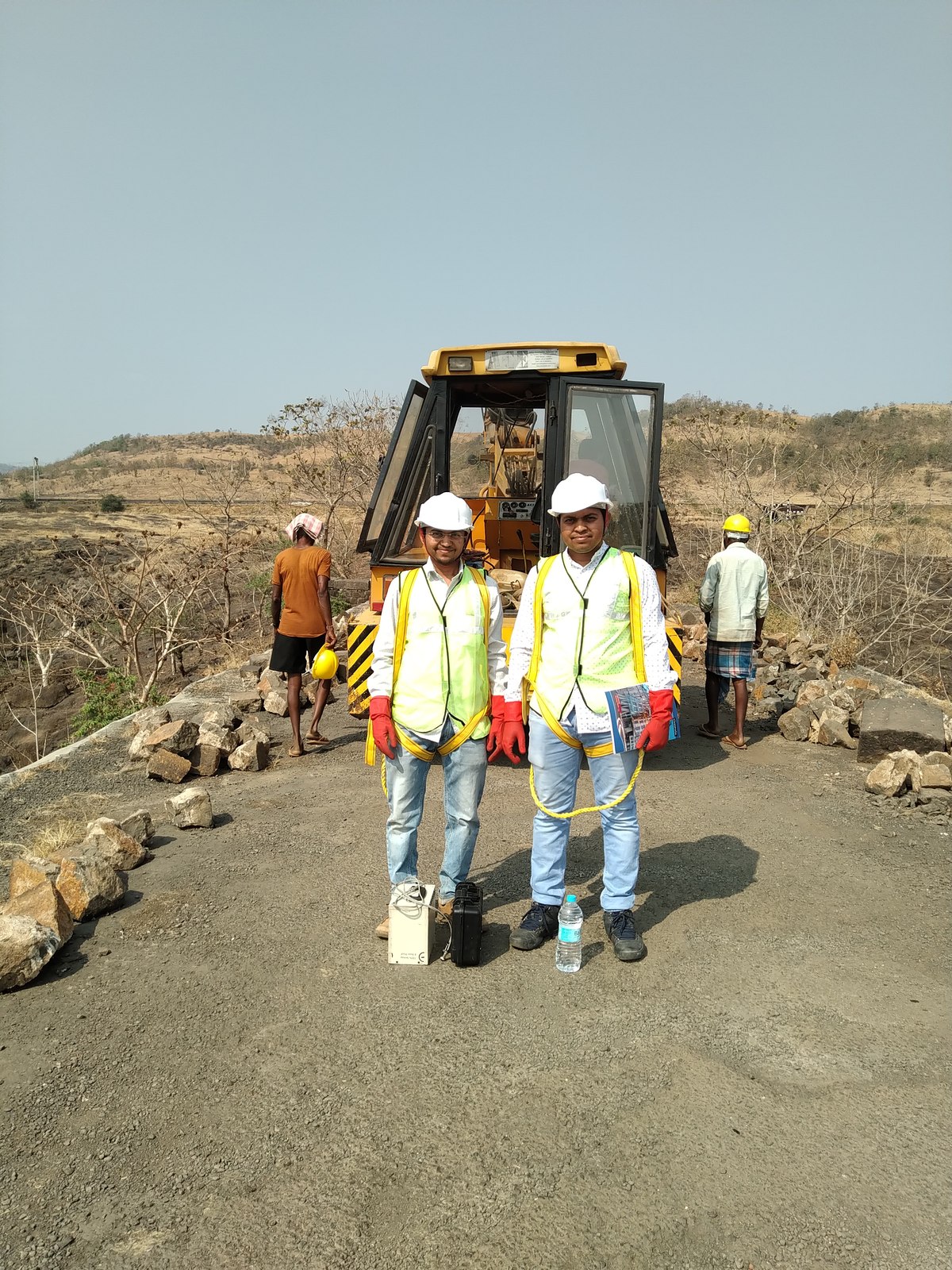
Scope of Work
- Investigation of vibration parameters generated by blasting and drilling.
- Assessment of the effect of that vibration on the structural integrity of buildings near the site.
- Vibration monitoring at multiple locations for each targeted blast area.
Method
Vibration sensors were installed at both the Turbhe side and the Kharghar side of the tunnel alignment, positioned to capture ground-borne vibration at the structures of interest rather than at the blast face itself. Monitoring was carried out around each blasting preparation and detonation event, with sensors placed at multiple locations for each targeted area so that vibration attenuation with distance from the blast could be assessed directly, rather than assumed.
Recorded vibration levels – typically expressed as peak particle velocity – were then evaluated against established safe limits for structures of the type present near the tunnel, giving the construction team a clear, continuously updated picture of whether blast design parameters (charge weight, delay timing, sequencing) needed adjustment to stay within safe bounds.
Findings & Significance
By monitoring at both portals through the duration of the blasting programme, Hone SHM gave the project a continuous, location-specific record of induced vibration at nearby structures – rather than a single point-in-time compliance check. That let the construction team demonstrate, blast by blast, that vibration exposure to nearby buildings remained within safe limits, and would have provided early warning had any blast design change pushed vibration levels upward.
Blasting vibration risk isn’t managed at the blast face — it’s managed at the structure you’re trying to protect.
This is the same investigation-of-vibration methodology Hone SHM applies to any construction activity – blasting, piling, deep excavation or heavy machine operation – taking place near a structure whose integrity or occupant comfort needs to be protected.