Background
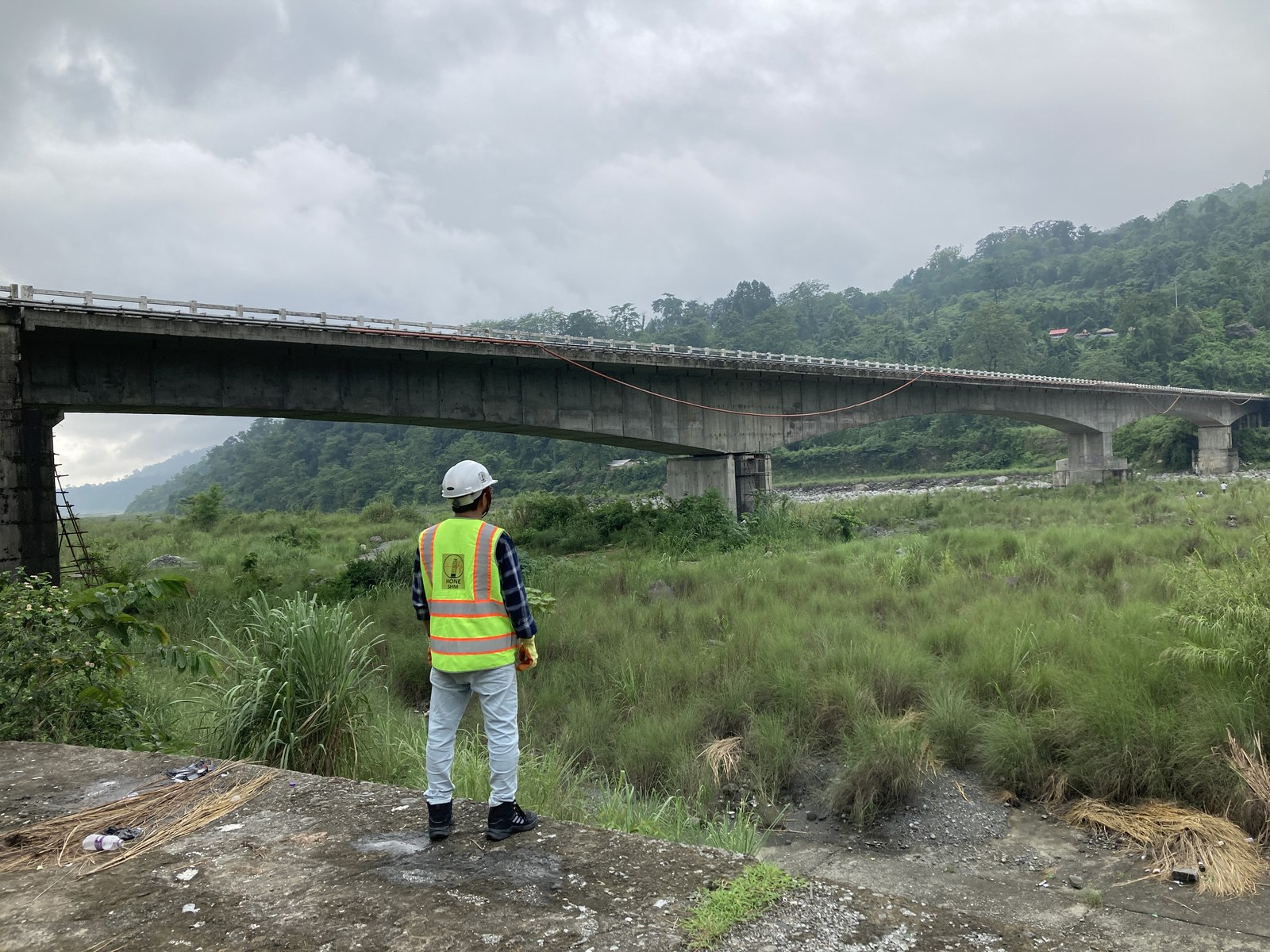
Bridge load testing exists to answer one question with certainty: does the structure, as built, respond to load the way the design intended? For the Deopani Bridge in Arunachal Pradesh, that meant subjecting the structure to a known, calibrated live load and measuring its full structural response – not just deflection in isolation, but the combined picture of vibration, strain, deflection and tilt – and checking that response against the limits set out in IRC SP 51 and IRC SP 37.
Scope of Work
- Bridge load test under calibrated live load.
- Measurement of both dynamic and static structural response.
- Simultaneous measurement of vibration, strain, deflection and tilt.
- Testing carried out as per IRC SP 51 and IRC SP 37.
Method
The bridge was tested under a series of calibrated live-load cases, covering both a static condition – load held stationary at defined positions to capture the pure static deflection and strain response – and a dynamic condition, with load moving across the span to capture the amplified, time-varying response associated with a moving vehicle. Instrumentation was distributed across the span to capture strain in the primary structural members, deflection at critical points, tilt of the superstructure, and vibration response throughout each load case, giving a single, time-synchronized dataset covering all four measurement types rather than separate, disconnected tests.
Why Measure All Four Together
Deflection alone can look acceptable while strain in a specific member is already approaching a limit; vibration response can flag a resonance issue that a purely static deflection test would never reveal. Testing vibration, strain, deflection and tilt simultaneously – against the same calibrated load case, at the same instant – gives a structural picture that no single measurement can provide on its own, and is precisely what IRC SP 51 and IRC SP 37 are designed to establish confidence in before a structure is cleared for its intended service loads.
A load test is only as good as the number of things it measures at once. Deflection alone tells only part of the story.
Significance
This engagement reflects Hone SHM’s Advanced Assessment service line applied to a live infrastructure asset: rigorous, code-compliant load testing that gives the bridge owner an evidence-based basis for certifying the structure’s load-carrying capacity, rather than relying on design assumptions or visual inspection alone.