
Background
The Global Vipassana Pagoda in Mumbai houses a meditation hall built as the world’s largest span pillarless stone masonry dome – a structural form with almost no steel reinforcement, where the entire load path relies on masonry acting in compression, exactly as in the ancient dome traditions our founder has published on extensively. Structures like this cannot be assessed with a single site visit; a masonry dome of this span needs to be watched continuously, because small changes in geometry or temperature can be early indicators of long-term behavior long before they would be visible to the eye.
Hone SHM designed and installed a permanent, IoT-based structural health monitoring system that lets the Global Vipassana Foundation monitor the pagoda’s structural condition remotely, around the clock, rather than relying on periodic manual inspection alone.
Scope of Work
- Geometry monitoring across the dome’s meditation hall.
- Temperature monitoring, to correlate thermal cycling with structural response.
- Vibration monitoring of the dome structure.
- An IoT-based SHM system built around a digital twin model of the structure.
How the System Works
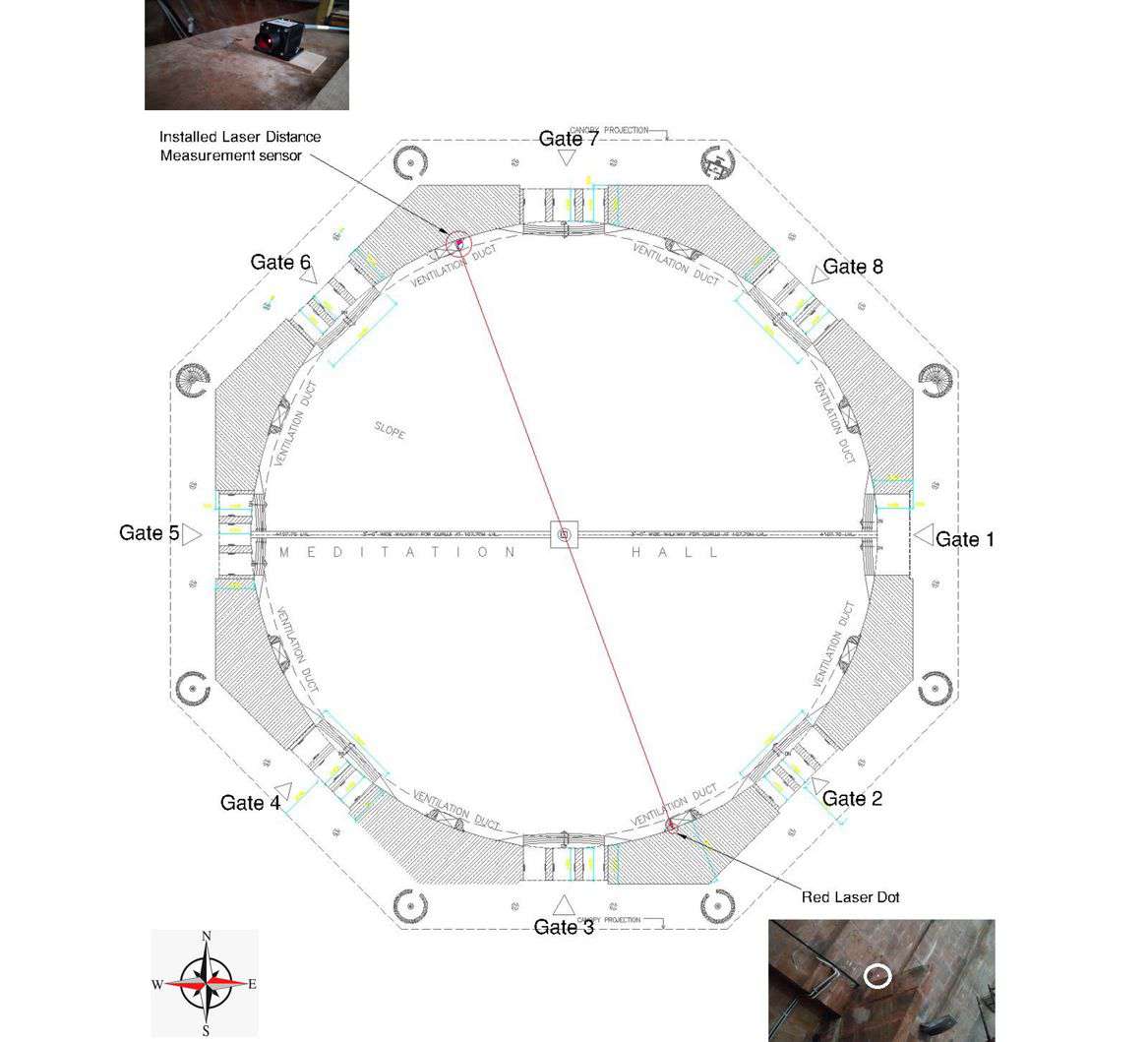
Laser distance measurement sensors are installed at key points around the octagonal hall – including diagonal lines of sight spanning between opposite gates – giving a continuous read on the dome’s internal geometry. A red laser dot projected across the hall provides a visual, verifiable reference point for each measurement line, letting field engineers confirm sensor alignment during commissioning and periodic checks.
Data from the sensors flows through a structured IoT pipeline:
| Sensing layer | Laser distance, vibration and temperature sensors mounted directly on the dome structure |
|---|---|
| Gateway | Local gateway aggregates sensor data on site |
| Network | Transmits aggregated data off-site |
| Cloud | Centralized storage and processing |
| OPC / Alerting | Automated alerts if readings move outside expected bounds |
| SHM OS | Structural health monitoring operating layer tying sensors to the structure’s digital twin |
The result is a closed loop: the physical dome is continuously mirrored by a digital twin model, so that any drift in geometry, temperature or vibration response is visible to the asset owner in near real time, rather than being discovered on the next scheduled inspection.
Why a Digital Twin, and Why Permanent Monitoring
Masonry domes carry load almost entirely through geometry – the shape of the compression arch is the structural system. That means geometry monitoring is not a cosmetic measurement here; it is a direct read on structural health. A digital twin model lets engineers interpret raw sensor readings against a structural model of the actual dome, rather than against generic thresholds, so alerts are meaningful rather than noisy.
Because the Global Vipassana Pagoda is both an actively used public meditation hall and a one-of-a-kind structural landmark, a permanent system that raises an alert before failure – supporting pre-planned, optimized maintenance – is a far better fit than periodic manual inspection alone.
The dome’s structural form is its structural system — which is exactly why continuous geometry monitoring, not periodic inspection, is the right tool here.
Significance
This installation reflects our founder’s doctoral and post-doctoral research into masonry dome mechanics – including a dedicated study of this very structure, “Grand Pagoda: world’s largest span masonry dome,” presented at the International Scientific Congress on Domes in the World, Florence – brought to life as an operating, permanent monitoring system rather than a one-time academic case study.