Background
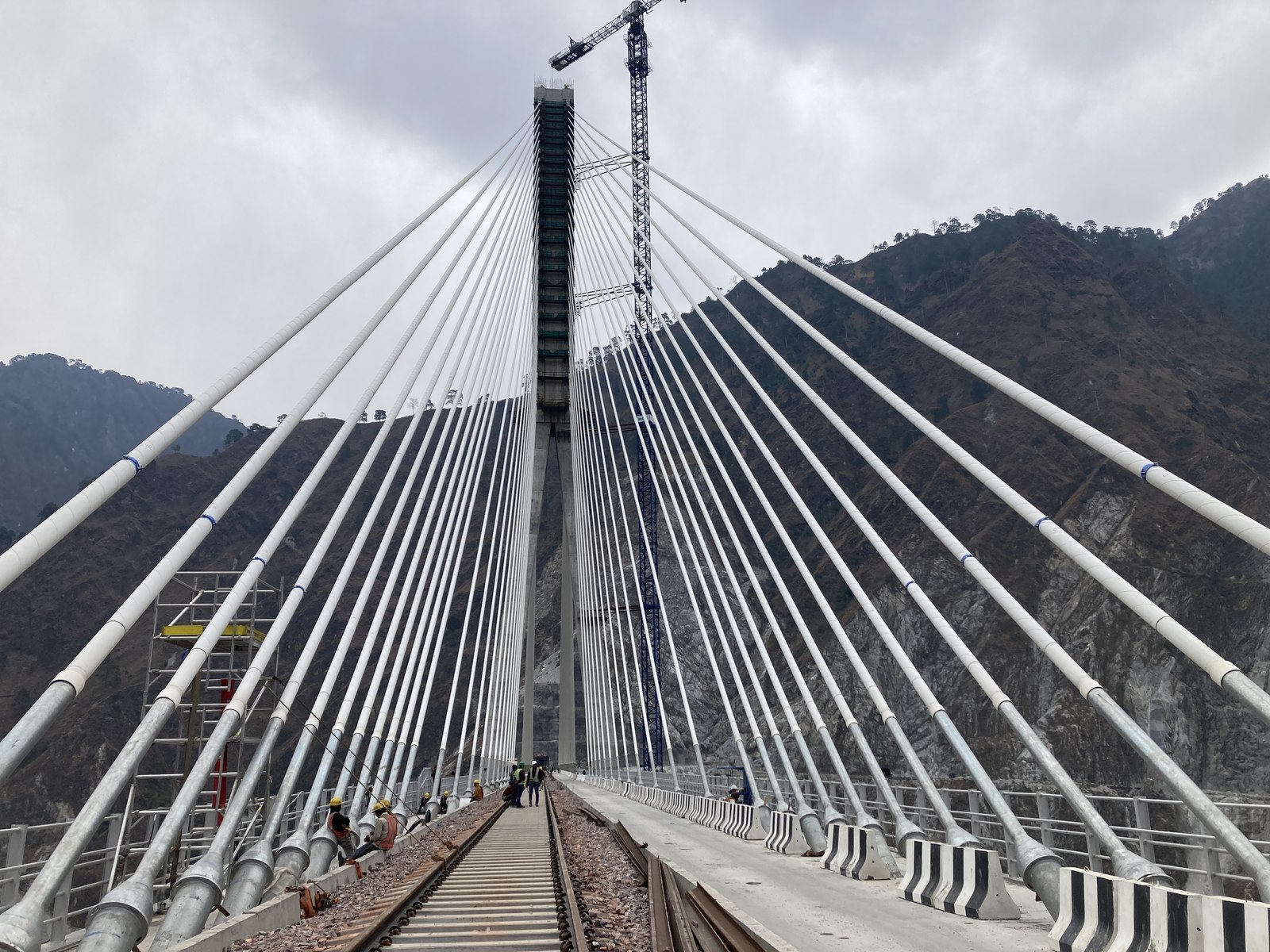
The Anji Khad Bridge, spanning a deep gorge on the Udhampur–Srinagar–Baramulla Rail Link in Jammu & Kashmir, is India’s first cable-stayed railway bridge. A single reinforced-concrete pylon rises from the valley floor, carrying the deck on cable stays running out to piers on either side — toward Katra on one end and Reasi on the other. Before a structure of this kind can be certified to carry revenue train traffic, its actual dynamic behavior has to be measured and reconciled with the behavior predicted by the design model.
Hone SHM was engaged to carry out that reconciliation: to measure the vibration response of every cable on the bridge, extract each cable’s natural frequency, and use that frequency to back-calculate the in-service tension force — comparing the result against the tension force assumed in the analytical model.
Scope of Work
- Measure the vibration response of all 96 cables of the bridge.
- Compare the measured frequency of each cable with the corresponding analytical model frequency.
- Evaluate the in-service tension force in each cable and compare it against the analytical model’s design forces.
Method: Exciting the Bridge on Purpose
Cable tension cannot be measured directly without cutting into the cable itself, so the accepted approach is indirect: measure a cable’s natural vibration frequency, then use the classical relationship between a taut cable’s frequency, mass per unit length and span to back-calculate its tension. That, in turn, depends on getting a clean vibration signal out of each of the 96 cables — which meant giving the bridge a controlled, repeatable excitation rather than relying on ambient wind alone.
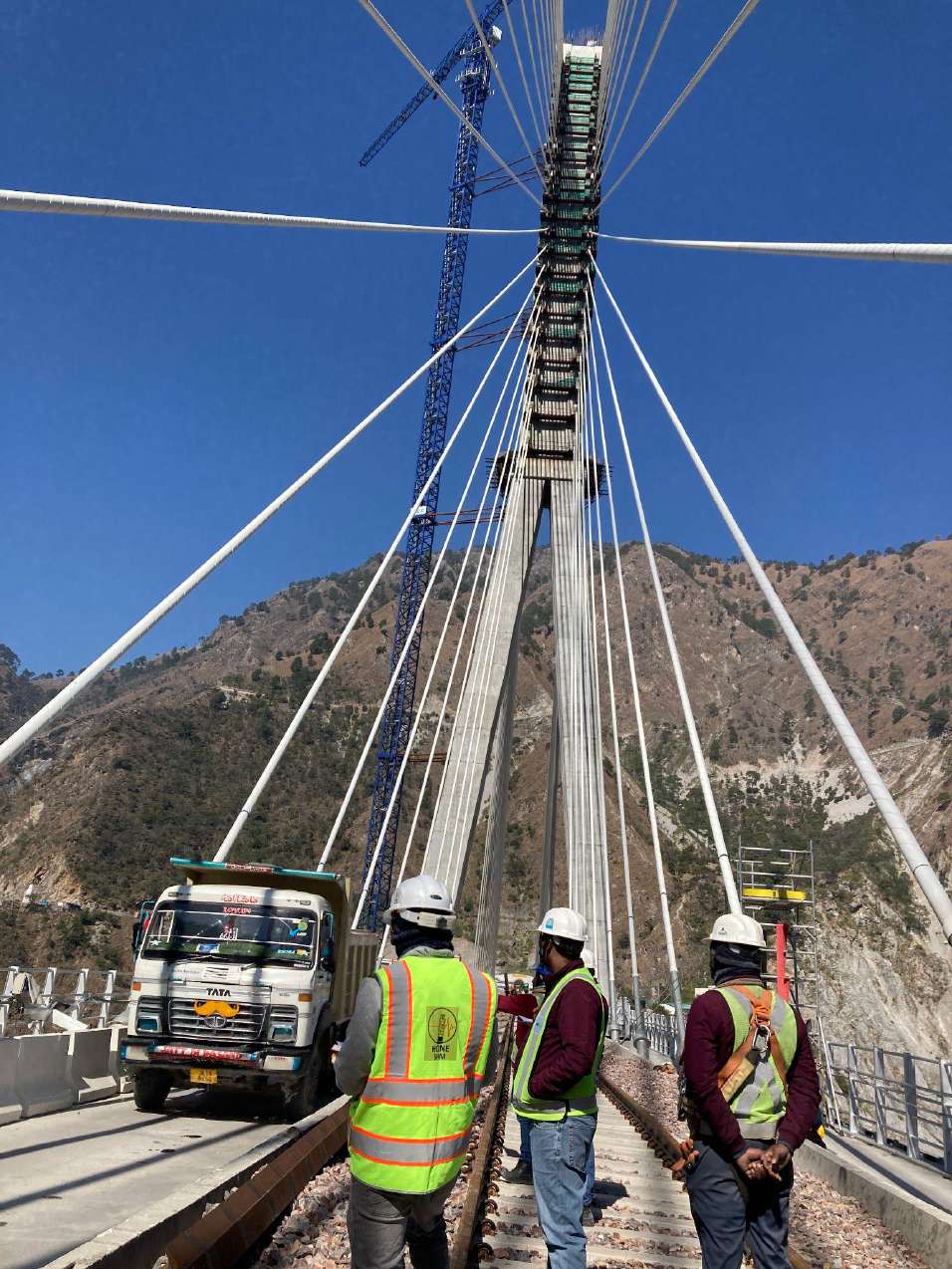
The field team introduced a speed hump on the deck and ran a calibrated test vehicle across it at a controlled speed of roughly 40 km/h, generating a short, sharp transient vibration each time the wheels crossed the hump. This transient excitation was repeated at multiple deck locations so that every cable received a usable input, while the heavy test trucks running in a dynamic state also gave a picture of the deck’s response under realistic moving loads.
Instrumentation
| Sensor type | Tri-axial accelerometers |
|---|---|
| Sampling rate | 1024 Hz |
| Connectivity | Wireless data acquisition |
| Ingress protection | IP65 – rated for exposed, high-altitude field conditions |
| Cables instrumented | 96 of 96 |
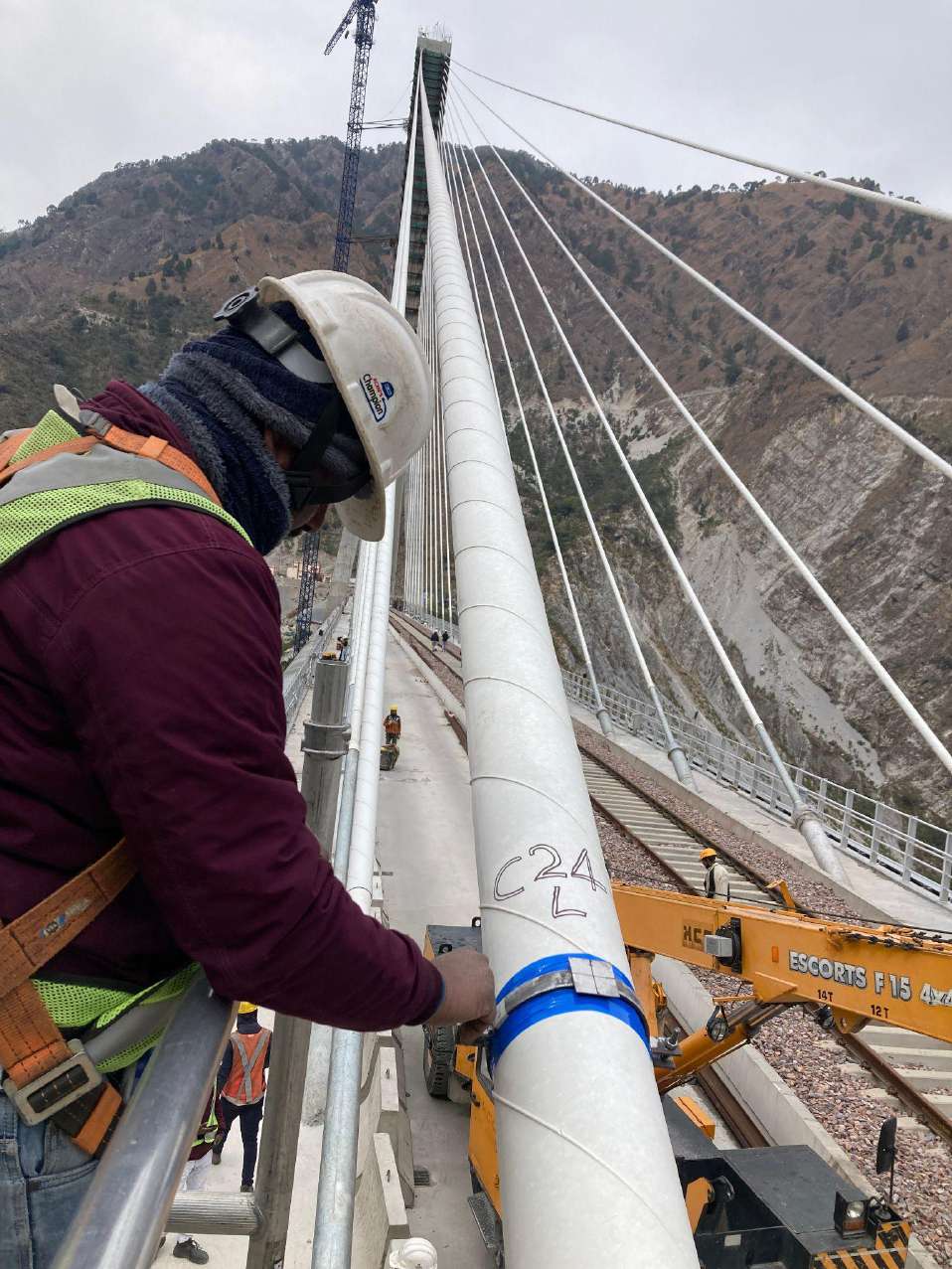
Each accelerometer was clamped directly to its cable and individually labelled – visible in field photographs as markings such as “C24L” and “C23L” – so that every recorded time-history could be traced back to a specific cable and cross-checked against the design drawings during post-processing.
Findings & Significance
By capturing a clean vibration record from each of the 96 cables and converting frequency to tension using standard taut-cable theory, the Hone SHM team was able to build a full, cable-by-cable comparison against the analytical model used in design. Close agreement between measured and predicted tension across the cable set provides direct, field-verified confidence that the as-built cable-stay system is performing as intended – a critical checkpoint before a landmark structure of this type is opened to regular train traffic.
Wireless, tri-axial, IP65-rated accelerometers sampling at 1024 Hz made it possible to instrument all 96 cables of a live construction site safely and without disrupting the works.
This project illustrates the core of our Advanced Assessment service line: cable tension and frequency measurement used to validate, rather than merely inspect, a structure’s as-built dynamic performance.