
Background
A jetty structure in Gujarat had undergone retrofitting work and needed to be cleared before it could return to handling vehicle and cargo traffic. Marine and port structures carry a particular kind of risk: the loading they see in service – loaded trucks, heavy cargo, repeated cycles – is often close to their design limit, and any weakness introduced or left unaddressed by retrofit work needs to be caught before, not after, re-opening. Hone SHM was engaged to provide that pre-reopening verification.
Scope of Work
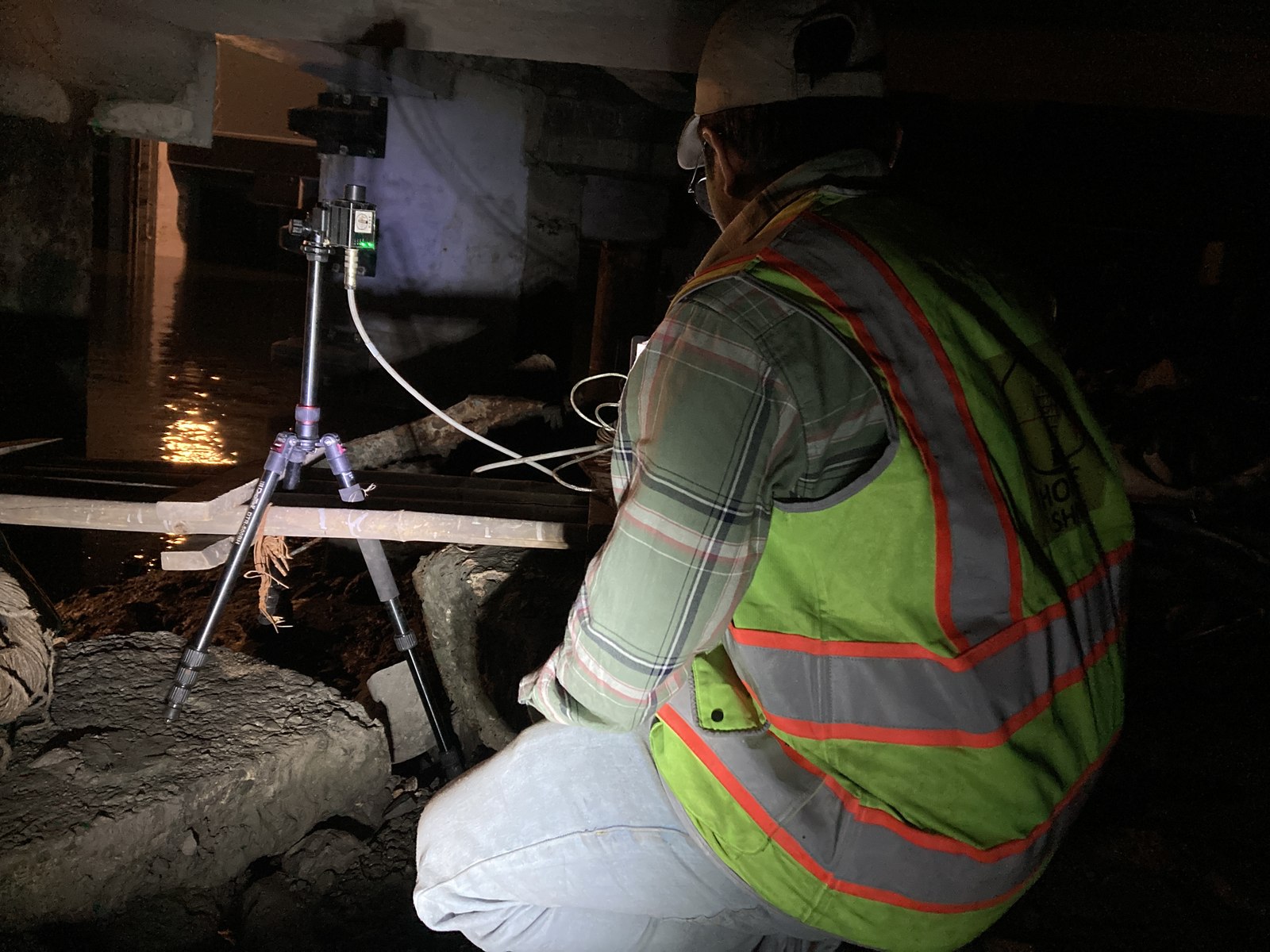
- Deflection monitoring under load.
- Vibration monitoring under load.
- Comparison of measured values against a mathematical (finite element) model, to validate the model and check performance against design loading.
- Loading using calibrated vehicles and cargo load.
- Testing carried out as per IRC SP 51:2015.
Method
The jetty was loaded using calibrated truck loads and, separately, heavy cargo loads representative of actual service conditions, while laser deflection sensors and accelerometers captured the structure’s response. Because a finite element (FEA) model of the jetty already existed from the retrofit design process, the field team was able to apply the same load cases used in the FEA model in the field, and compare measured deflection and vibration directly against the model’s predictions – rather than only checking measured values against a generic code limit.
| Loading | Calibrated truck loads & heavy cargo load |
|---|---|
| Instrumentation | Laser deflection sensors, accelerometers |
| Validation method | Direct comparison against FEA model under matching load cases |
| Test standard | IRC SP 51:2015 |
| Context | Post-retrofitting inspection prior to re-opening |
Why Validate Against the FEA Model, Not Just the Code Limit
A structure can pass a code deflection limit while still behaving differently from how its retrofit was designed to make it behave – and that gap, if it exists, is exactly what a responsible owner needs to know about before returning a marine structure to heavy service. By loading the jetty with the same calibrated cases used in the FEA model and comparing results side by side, this assessment confirmed not just that the jetty was within safe limits, but that it was behaving the way its retrofit design intended.
Passing a code limit and matching your design model are two different kinds of confidence. A jetty going back into heavy service deserves both.
Significance
This project is a clear example of Hone SHM’s post-retrofitting inspection service: field-measured performance, benchmarked directly against the engineering model, giving the asset owner evidence-based confidence before a structure returns to service – the same standard we apply whether the structure is a jetty, a bridge, or an industrial building.